Thursday, July 17, 2014

Robotic Surgery: An Ethical Dilemma?


Our local hospital has a "da Vinci Xi Surgical System", you can learn more about it here: There are only 10 units doing surgery as of July 2014. This is the future, today. I have been hammering the healthcare system with my series of posts on "Patient Dignity" (a.k.a. patient modesty). When I saw the "da Vinci Xi" (pictured below), I was thinking that this is a good thing! But, I was thinking in terms of "Patient Dignity" (same gender care, draped properly, no unnecessary people in the room, etc. Then I realized that this is a piece of advertising.

Of course it looks good, that is what it is designed to do. Just look at "11 Ways Advertisers Make Food Look Delicious" (on mentalfloss.com). So I decided to put aside the issue of "Patient Dignity" in regards to robotic surgery. I have to assume less people in the room is a good thing for the dignity of the patient.

But there is a pitfall: How many on the hospital staff are going to want to see this "wonder of medicine" in action? How many people will be "popping in?" Will they broadcast live video, rebroadcast it, and do this in an "Operating Theater?" Who will get to see it, medically licensed professionals only? Will the manufacturer want video of it in action for promotional pieces, will medical schools want video for educational reasons? Will the corporation that owns the hospital want video for promos?

What say will the patient have in spectators permitted and the procedure being videoed or not? This circus of spectators reminds me of the 1889 oil painting by Thomas Eakins, "The Clinic of Dr. Agnew."


Can the hospital ethically say:
"We need to film your procedure to further learning of medical students, if you refuse we cannot schedule you for robotic surgery, you must have traditional surgery. Based on the principle of utilitarianism (John Stuart Mill), spectators and video taping cures you, promotes learning, and we received this unit at a discount by providing the manufacturer with video of procedures, otherwise it would not be here."
I believe that robotic surgery is the same as any surgery in regards to patient dignity. So I will leave that issue for my series on "Patient Dignity." So other than the issue of patient dignity, there are no other ethical issues, and it is a good thing. Maybe not...

There are pros and cons to robotic surgery, and specifically to the "da Vinci Xi." I will list the pros and cons to both robotic surgery and specifically the "da Vinci Xi" together:

Pros:

  • For the patient, there's usually less blood loss, a shorter hospital stay and less reliance on postoperative pain medication. There's also the cosmetic benefit of no big scars: As in laparoscopic surgery, the instruments enter the body through small incisions.
  • For surgeons, the procedures can be less tiring. They don't have to bend over an operating table, they can sit in front of a screen with a magnified, full-color 3-D view of the surgical field. For maneuvering in very tight spaces, the enhanced screen image makes it much easier to see. 
  • Overall costs to patients: A robotic procedure may mean less need for pricey items like blood transfusions and post-op pain meds. Patients may also spend less time in the hospital and have a lower chance of readmission for complications.
  • Robot hands don’t shake and they can twist and rotate in more directions than human hands. 
  • By 2009, 85% of the 85,000 U.S. men who had prostate-cancer surgery to have their prostates removed by the da Vinci system (Source: Intuitive Surgical Inc. of Sunnyvale, California).
  • The robotic arm can make finer, more precise movements, with greater accuracy than the human hand.
  • A map of the organ or structure, developed from radiology images, with landmarks or surgical points highlighted, can be superimposed over the realtime endoscopic video.
  • The endoscope allows the surgeon a better view of the organ or structure.


Cons:

  • Da Vinci robots were approved by the U.S. Food and Drug Administration (FDA) in 2000. Since its approval, there have been 4,600 adverse events reported to the FDA, which amounts to an average of one problem per day by June 2013.
  • Robotic surgery complication rates may be no better than those of traditional laparoscopic surgery, according to an article published in the Journal of the American Medical Association (JAMA).
  • Cost: A study published last year by surgeons at Brigham and Women's Hospital in Boston showed these average total patient costs for different types of hysterectomies: $49,526 for a robotic procedure, $43,622 for abdominal, $28,312 for laparoscopic and $31,934 for vaginal.
  • More chance of nonessential people (non-medical personnel, students, medical personnel not directly involved in the care) wanting to see the technology in action. 
  • More chance of the procedure being filmed.
  • No expert consensus on how much training is needed. A 2010 New England Journal of Medicine essay by a doctor and a health policy analyst said surgeons must do at least 150 procedures to become adept.
  • Machines break, power can go out, computers can freeze; even though there is redundancy built in, things can still go wrong.


Here are some facts about Robotic surgery:

  • The term "robotic surgery" refers to "robotic assisted surgery." A surgeon sits at a computer console in the operating room, directing the long robot arms with hand controls. The arms are tipped with tiny surgical instruments and one has a video camera that lets the surgeon view the operation on the computer screen.
  • The world’s first surgical robot was the ‘Heartthrob’, which was developed and used for the first time in Vancouver, BC, Canada in 1983.
  • Robotic surgery devices generally include 3 critical tools which include a robotic arm, endoscope and monitor, and a tele manipulator which enables the doctor to simulate their hand movements with the movements of the robotic arm.
  • Major advances aided by surgical robots have been remote surgery, minimally invasive surgery, and unmanned surgery. 
  • The surgical robots that have been developed for use include Da Vinci Surgical System, ZEUS Robotic Surgical System, and the AESOP Robotic System.
  • Robotic surgery gained popularity first among prostate surgeons, who like its precision in working with delicate male organs.
  • The U.S. Food & Drug Administration (FDA) web page about robotic surgery can be found here:


The "da Vinci Xi" at first glance reminded me of Number "Johnny" 5, from the 1986 movie "Short Circuit." It can be scary to look at to some people. Some patients may feel dehumanized being treated by a robot.


This also reminded me of a theory that science fiction predicts future technologies.  Studies have shown that cultures with rich collection of science fiction prose, have greater technological advances. These include ancient cultures to modern day cultures. Here are some sources of this theory:

  • Thomas Clareson: "Science Fiction Criticism" (Kent, OH, 1972) 
  • Roy C. Amara and Gerald R. Salancik; "Forecasting: From Conjectural Art Toward Science" The Futurist (April 1969)
  • Albert Somit: "Political Science and the Study of the Future" (Hinsdale, 11., 1974)
  • Dennis Livingston; "Science Fiction as a Source of Forecast Material," Futures, I (March 1969)

Proof of this comes from the 1960's television series "Star Trek." The communicators predict cell phones. Motorola's "StarTAC" cell phone not had an uncanny resemblance to the Star Trek communicator, but the name closely resembled the title "Star Trek." There are also flatscreen television, the tricorder (see the iphone in medicine here:), and laser pointers.

I think the most realistic look into the future of medical robots comes from the movie "Star Wars Episode III: Revenge of the Sith"(2005)  and "Prometheus" (2012), part of the movie "Alien" (1979) franchise.

In "Star Wars Episode III: revenge of the Sith," Darth Vader then engages Obi-Wan Kenobi in a lightsaber duel which ends when Obi-Wan severs Vader's legs and remaining organic arm mid-air. Vader then slides too close to a lava flow and sustains life-threatening third-degree burns. Darth Vader is saved by medical droids (robotic surgery) who treat his injuries and reconstructed his body with the cybernetic limbs and the black armor. Also note the use of cybernetic limbs.


The second vision of robotic surgery coves from "Prometheus." I believe that this is a more realistic view of what is to come. The medical droids in "Star Wars" were totally autonomous and to some extent "self aware." (See reference of self awareness here:) The term "droid" is "Star Wars" nomenclature and short for android;  a robot with a human appearance.


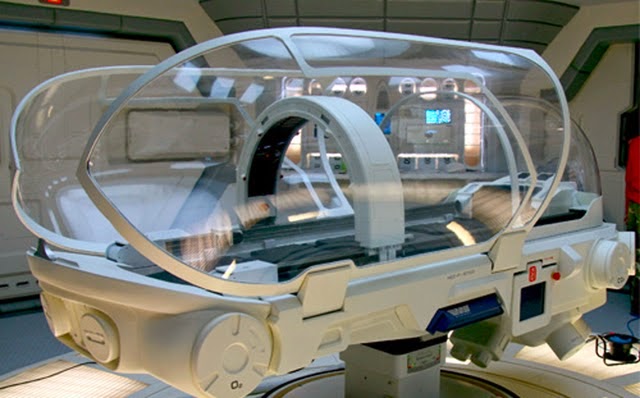
The surgical robot in "Prometheus" is called the "Medical Pod 720i." The definition of "pod" is self-contained unit on an aircraft, spacecraft, vehicle, or vessel, having a particular function. The "Medical Pod 720i"is semi-autonomous. It needs to be directed by a human being, when there is a conflict (machine doesn't know what to do), then a person has to resolve the conflict with in the machine's capabilities.

Essentially the "Star Wars" droids direct the examination, diagnosis, decision on treatment/procedure, and treatment the medical condition. They can be overridden by humans. In "Prometheus" the person directs the "Medical Pod." The human can examine or request an examination. The machine can suggest a diagnosis and treatment, but the person must ultimately decide the diagnosis and treatment. The person also direct the treatment or procedure. Here is a YouTube video of the "Medical Pod 720i" from  the movie "Prometheus" in action:


This is how I see the evolution of robotic surgery:

  1. The surgical instrument: the first extension of the human hand being.
  2. Power assisted mechanical surgical instruments (surgical drill).
  3. Mechanical laparoscopic surgical instruments.
  4. X-Rays, MRI, CTs, laparoscopic video, etc.; advances in imaging.
  5. Energy surgical instruments (surgical laser).
  6. Powered laparoscopic surgical instruments (da Vinci Xi).
  7. Powered laparoscopic surgical instruments with advanced imaging. 
  8. Hands free powered laparoscopic surgical instruments. 
  9. Computerized diagnosis and treatment recommendations.
  10. Hands free powered laparoscopic surgical instruments with advanced imaging. 
  11. Hands free powered laparoscopic surgical instruments with advanced imaging, body mapping, and organ recognition. 
  12. Hands free powered laparoscopic surgical instruments with advanced imaging, body mapping, organ recognition, and preprogrammed procedures ("Medical Pod 720i").
  13. Autonomous medical robots ( "Star Wars" medical droids).

Ethically it comes down to the doctor's diagnosis and recommendations, patients' choice, full disclosure, patient dignity, and "NO STRINGS ATTACHED." 

By doctor's diagnosis and recommendations, I mean the doctor diagnosis the disease and ONLY recommends the course of treatment. This includes if the patient is a candidate for robotic surgery, if there is a less invasive technique, or if "hands on" surgery is the best route. The best example of  "hands on" surgery that I can think of is plastic surgery which is just as much art as science.

At this point the patient chooses which treatment. A patient may prefer "hands on" surgery. It must be the patient's choice. When I say full disclosure, I do not mean the fine print on page 18 of the admission form that the patient signs at 5AM when being admitted on the day of surgery. This is beyond the risks, this is about who will be in the room, who is necessary to be in the room. There should be NO "maybe's, only "in the event of's."

Patient dignity has special considerations in robotic surgery due the the "wow factor" of the technology. It should not be broadcast world wide on pay-per-view. It should not be done at Madison Square Garden. If the unit records video from the endoscope, the patient should have full disclosure as to what happens with that video, and full control as to who is allowed to view it.

No strings means "NO STRINGS AT ALL!" Ethically, strings are the same as coercion. If a patient wants no spectators, students, or recordings, they CANNOT be denied robotic surgery. Saying "the unit automatically records video and we can't do nothing about it" is a STRING! Pre-negotiated contracts with third parties (such as the manufacturer) for things that are in the realm  of patient control are STRINGS! A discount to the hospital from the manufacturer for a video of all procedures is a STRING (and coercion).

The conditions (other than direct health related) on receiving robotic surgery should be no different than that of receiving laparoscopic surgery.

Me, I welcome robotic surgery, and at my insistence, it will NOT be a spectator sport for me.

Thank you for reading.


Tuesday, July 15, 2014

Patient Dignity 04: "Patient Dignity," "Human Dignity," and "Patient Modesty"

 I prefer the term "Patient Dignity" or  "Human Dignity" over "Patient Modesty."
Modesty is defined as behavior, manner, or appearance intended to avoid impropriety or indecency.
Dignity is defined as a concept used in moral, ethical, legal, and political discussions to signify that a being has an innate right to be valued and receive ethical treatment.
Using the term "patient modesty" implies that the patient is asking for consideration that is exorbitant, burdensome, cumbersome, and unreasonable. Modesty is something that the healthcare system will hand out at their convenience after checking that your expectation level falls within normal parameters (set by the healthcare system).

Modesty implies more than your fair share. When we describe someone as being "modest" in their form of dress, it is implied that they are going beyond the norm. A modest skirt comes to the ankles when everyone else is wearing mini skirts. Just as in healthcare, an extreme clothing example would be the Muslim hijab.

The healthcare system justifies blaming the patient for modesty issues. "What is wrong with you, why are you not like everyone else who is normal?" This leads to the solution (you should) "just get over it." Modesty can be traded off for necessity.

Patient Modesty in respect to Patient Dignity justifies the patient's chosen level of modesty (needs) and requires the provider to meet those needs. Using the term "Patient Modesty," while technically correct, connotates something that may be deemed unreasonable.

Dignity is an innate right. By the fact that you are a human being, you carry with you human dignity with you. Dignity affords a certain level of ethical treatment defined by the outcome, NOT the input.

By that I mean that today the healthcare system has sheets for draping, curtains to block accidentally open doors, and same gender providers (the input).  The healthcare system uses drapes, curtains, and same gender providers where feasible and when available (the output).

The Hierarchy of Dignity in reference to the healthcare system.

  • Human Rights ==> Are "commonly understood as inalienable fundamental rights to which a person is inherently entitled simply because she or he is a human being."[2] Human rights are thus conceived as universal (applicable everywhere) and egalitarian (the same for everyone).
  • Dignity ==> The innate right to be valued and receive ethical treatment.
  • Human Dignity ==> The ethical treatment of human beings. Human Dignity is a subset (specific type) of Dignity, AND a specific Human Right.
  • Patient Dignity ==> The ethical treatment of human (medical) patients. Patient Dignity is a subset (aspect) of Human Dignity.
  • Patient Modesty ==> The right to ethical treatment of the patient to determine the parameters (usually dealing with body exposure) that they are comfortable with. The parameters of exposure can include level of exposure, gender of those exposed to, when exposure is necessary. Patient Modesty is a subset (aspect) of Patient Dignity. 
  • Gender Preference ==> The preference of the gender of the provider. Gender Preference is a subset (aspect) of Patient Modesty. 

Self-Determination is a Human Right, defined as the process by which a person controls their own life.
Human Dignity allows for there being different levels of trust. Self-Determination allows the individual to assign levels of trust. A person, group of people, organization, etc. can raise or lower the level of trust a person has in them. (Businesses call it advertising.)

Patient Dignity is no different. An individual patient may place a higher level of trust in a provider, thus increasing the comfort level and reducing the requirements for patient modesty. A good provider, that builds a relationship with a patient builds trust and may lower the patients needs of modesty.

A provider like New York Presbyterian Hospital reduces trust (as in the 2003 forced rectal exam of Brian Persaud), thus patients may require higher levels of patient modesty from NYP.

Negotiations are allowed. Coercion is NOT allowed.
Coercion is defined as the to use force or intimidation to gain compliance.
Coercion is contrary to Self-Determination because the individual is not making choices freely and without duress.

Coercion would be: I will drop you as a patient because you are not complying with me by fact that I am the doctor. To do that, it will cost some large, arbitrary amount. You know catheters come in sizes from small to "fist." So by refusing a DRE, you are refusing all care, so I will let you die.

Negotiation would be: Let's first talk about your expectations... There is an alternative procedure, but your insurance only covers it as out-of-network.  There is an alternative procedure, but  the outcomes are not as good. To have all male providers, we have to schedule that 3 months from now, I can do it in office today, but my nurse is female.

There is a fine line between coercion and negotiation. It comes down to the factual accounting of the penalties or rewards between the choices. If to provide for a all male procedure, a male provider  (nurse) for the procedures is brought in from the outside, the all male procedure is subject to the schedule (comes in once a month) of the "outside" male provider, and the all male procedure schedule is booked 3 months out: negotiation.

If the difference between the penalties and rewards is arbitrary (and sometimes exorbitant), it is coercion. You don't want to do this today with a female, then you have to wait 6 months. (Thinking: the schedule isn't full, but the time frame in long enough and inconvenient enough to FORCE you to comply with my wishes.)

So where are we left? "Patient Modesty" and "Patient Dignity" are technically the same, and interchangeable. As I stated, I prefer "Patient Dignity."

Which do you prefer? Please comment.

Thank you,

--Banterings

Patient Dignity 03: The Groundwork Laid

Up to this point, I have been trying to lay the groundwork for a different perspective, that of (some) the patients. I am attempting to validate a view that has been marginalized. As proof of the validity of this view, I had offered an analysis of sexual assault, where the actions of both seem similar.

I was offered the advice to take a more neutral point of view, and will attempt to do this. My goal is to stimulate critical thinking, and perhaps look a this topic from a different perspective. Just as any person gaining knowledge and seeking wisdom, I am always open to the fact that I may be totally wrong.

I have also allowed anonymous commenting.

I would also like to thank Dr. Maurice Bernstein who moderates the "Bioethics Discussion Blog." Not only has him and his blog been an inspiration, but he has offered feedback to me both in the discussion of topics on his blog and running a blog. If you are reading my blog, I urge you to look at his blog, He covers the ethical issues in medicine and biologic science.

If nothing else, have we not learned this from history? There was a time when the Earth was thought to not only be the center of the solar system, but the center of the universe (I could argue the latter based on the theory of relative position).

That being said,

PLEASE COMMENT!!!

Thank you,

-- Banterings

Monday, July 14, 2014

Patient Dignity 02: But it is Sexual...

One of the things patients are told by the medical profession today is that even though a physical exam exposes and touches body parts, it is not sexual. This is absolutely incorrect.

Let's look Bates Guide to Physical Examination and History-Taking (Eleventh Edition). Chapter 13 Male Genitalia and Hernias states:
"Occasionally, male patients have erections during the examination. If this happens, explain that this is a normal response, finish your examination, and proceed with an unruffled demeanor." 
The response can be to fear and anxiety, the physical stimulation of being exposed or touched, or all of the above. The point is that along with it being an automatic reflex, it is also a SEXUAL response.
"That women can experience genital response during unwanted sex or when viewing depictions of sexual assault suggests that women's vasocongestion response is automatically initiated by exposure to sexual stimuli, whether or not these stimuli are preferred, and without subjective appraisal of these stimuli as sexually arousing or desired." (Source: Agreement of self-reported and genital measures of sexual arousal in men and women: a meta-analysis. Meredith L Chivers, Michael C Seto, Martin L Lalumière, Ellen Laan, Teresa Grimbos, February 2010)
Although the article Agreement of self-reported and genital measures of sexual arousal in men and women: a meta-analysis looked the connection between the mind and genitals during sexual arousal, that article and most of the 88 articles it cited, discuss different stimuli that produces sexual arousal both physical and mental.

This is important because as I said in my previous post we are only going to look at actions, because they can be measured. This study (along with most of the 88 articles it cited) also discussed the difficulty in measuring physical sexual arousal. Obviously it is easier in men, but still presents challenges (erectile dysfunction for example).

From this, we have to take away that there is some percentage of providers who experience some form of sexual arousal when performing exams or procedures. I am not going to argue what the percentage is, but you cannot deny, just by the number of providers in the United States, times the numbers exams or procedures that they perform each day, there are a certain number of sexual responses.

I am not saying that these responses may are intentional, they may just be a reflex from stimuli, just the way some men may elicit an erection during an intimate exam.

Here is the problem, the medical system tries to convince itself and the patients that this is not sexual. When a man has an erection, he knows that is a sexual response, the provider knows that too. Yet both say to themselves, this is not sexual. This creates a conflict without a clear resolution. This is the mental equivalent of "dividing by zero."

The same goes for a provider who may experience sexual arousal during a procedure or exam. There are studies on the anxiety doctors face from these exams, so a response of arousal may be from the fear, stress, or anxiety too.

Even though this is not (suppose to be) a sexual situation, it feels like a sexual situation. Now couple the feeling of being violated with the feelings of a sexual nature, you can further see why I contend that some patients have the feeling of having been sexually assaulted after an exam or procedure.

Addendum: Freud's Psychosexual Development, and Rape; Further Evidence that Medical Procedures are Sexual


1.) Freud's Psychosexual Development

You can read about Freud’s Stages of Psychosexual Development here, if you are not familiar with them. I am just going to refer to the Oral Stage, Anal Stage, and Genital Stage. Psychosexual Development is based on linking the mind with these "sexual regions" of the body. The breasts can also be considered part of the oral stage of development.

I am sure that everyone can accept human "sexual regions" defines as breasts, genitals, anus/rectum, and the mouth. The mouth may be questionable by some, but following Freud's theory, it fits in as a "sexual region."
Note: Do not confuse the sexual regions with erogenous zones.

A bonus to my argument is the "Phallic Stage." At this stage children learn the differences between "male" and "female" and the gender differences between "boy" and "girl". They also learn modesty and "that it is wrong to expose yourself to others." This defines their boundaries.

2.) Rape

As I stated before, I prefer the term "rape" over "sexual assault." Rape is NOT a crime of sex. Rape IS a crime of assault. Rape is about power, domination, humiliation, the infliction of bodily harm and physical damage. Sex is the weapon used in rape.

When I say sex is the weapon, by sex I mean sexual contact. Sexual contact is when the perpetrator uses the senses (visual, auditory, gustatory, olfactory, and tactile) on the victim's sexual regions. It is not only touching; see Johns Hopkins to pay $190 million for OB-GYN who secretly recorded women in examining room:

So my point is that sexual contact is the weapon used in rape (sexual assault). 

The Medical Procedure

Remember, I am taking intent out of the equation. The intent of rape is not sexual pleasure, it is assault. Sex is the weapon of rape.

Weapon is defined as: a tool designed or used for inflicting bodily harm or physical damage. 
Tool is defined as: a device or implement, especially one held in the hand, used to carry out a particular function.
So sex is the tool used to inflict bodily harm and physical damage in rape.

Many Definitions, Many Meanings. 

Words can have many meanings depending on who is using them. Just look at The Free Dictionary's definition of "call" here: There are 17 meanings as a verb and 15 meanings as a noun.

The average person thinks that "sex" is the same as "making love," but it is not. I will be defining the terms from a psychosocial and anatomical point of view. I am also taking the "intent" out of the definitions and only focussing on the observable actions.

Sexual contact is the act of manipulation of, OR using the senses (visual, auditory, gustatory, olfactory, and tactile) on the a person's sexual regions (defined above), OR contact with the sexual regions, including penetration (however slight) of any orifices in the sexual regions with a body part or object.

Making love (the average person's definition of "sex") is the consensual act sexual contact involving 2 or more people, usually for the purposes of (but not limited to) bonding, physical pleasure, intimacy, that include physical, mental, and emotional aspects of the participants. (Other purposes may include revenge, exercise, consoling, etc.)

You can see that sexual contact is an act, a motion, a tool. Depending on the use of the tool (sexual contact), the context is defined.

Sex (sexual contact) is a tool. 

In a relationship (marriage), it builds intimacy and trust. In rape, it is the weapon of assault. In procreation (dare I say animal husbandry), it is the tool to produce offspring. In nature, it is the means of perpetuation of the species. In medicine it is one of the tools of exam and treatment.

Addendum (Some info I found after completing the original post)


I found an article in the March 16, 2006 issue of Nursing Standard, (published in Great Britain),  titled "Male Urinary Catheterisation" by Willie Doherty who is a clinical nurse specialist. 

After discussing what the process is and why one does it, Doherty has a section called "The Role of the Female Nurse."

In the past, he says, only males did this procedure on males. But the result was that males had to often wait too long in pain to get the job done, so female nurses were taught the procedure. Doherty discusses the intimacy of the procedure as says now males can have the procedure done without having to wait. But, he writes:
"However, patients should always be give the choice of the gender of the nurse or doctor performing this intervention, as with any other clinical situation or intimate procedure. The patient's wishes should be foremost in the decision making process and he may not wish a female nurse to undertake this procedure." 
He does say to offer the male patient a chaperone of the same gender, and specific to our current discussion about chaperones, he writes:
"The Royal College of Nursing (2002) and the General Medical Council (1998,
2001) have published guidelines on chaperoning and intimate examinations and the nurse should be aware of local policy on chaperoning." 
These British policies indicate that patients should always be offered a chaperone of the same gender.

Doherty has a section in this article about male sexuality in which he writes:
"Male sexuality is an important consideration for female nurses undertaking male catheterisation.
Milligan (1999) stated: ‘the penis is considered by many to be the focus of male sexuality. Compared with female sexuality, male sexuality is more concerned with power and performance and more physical (Lawler 1991). This has an
impact on the practitioner and the male patient as the penis is being manipulated (Fader 1986).

 How much of this kind of psychology/sociology is even covered in doctor/nurse training? If it is covered, it seems to be set aside or forgotten soon after the doctor/nurse gets into the healthcare "system." 
Further proof of the sexual nature of medical exams and procedures.

Medical schools have training to take sexuality out of the equation for medical practioners who examine naked patients. Unfortunately, patients are not afforded the same training.

Consider the Pelvic Exam:

It is really surprising that there is still  controversy about the sexuality of physical exams. Consider the question of male doctor eroticism during a pelvic exam. The medical community recognizes it's existence. Medical textbooks (at least into the 1980's) cautioned the young male medical student that it is "inevitable and unavoidable" that erotic sensations will occur while doing a pelvic exam.

Medical students relate stories that male professors would often comment that "if you do the pelvic correctly you won't need extra lube when you do the bimanual exam." Occasionally medical journals publish cautionary memoirs about young male doctors who "fall in love" with female patients while looking at and feeling the patient's breast and genitals, the tale always ending with a warning from an older colleague.

The medical profession has frequently ordered surveys by medical school personnel to determine the extent of sexual violations during intimate encounters in the doctor's office. The published results of self-confession indicate high rates of abuse by male gynecologists, sometimes running as high as 20%.

When male gynecology developed over one hundred years ago there was no denial of eroticism for the male. The novel practice of a man examining the female anatomy was simply defended as a practical necessity - there was no female in the profession to do the job. You want good health, you go to the male doctor.

Textbooks and procedures acknowledged the sexual nature of the exam and doctors quickly set up the chaperone system to reduce the tension. It is only recently as female doctors have moved into the field.

It is an absurd notion that a male can examine a female body in the most intimate manner, and experience absolutely no sexual response. In other words, it has been discovered that male gynecologists are unique in the human species - after six million years of evolutionary development in which the male "automatically" responds to the sight and touch of the female genitals, this all can be blocked out by a couple years in the medical lab.
I am not absolving women either. One has to ask, what about the female doctors who may be lesbian/bisexual/curious? The primary sexual stimuli for women is different than that of men, but erotic sensations can occur while doing a pelvic exam. I'm sure there are just as many woman out there who enjoy it as there are males.

Even Heterosexual People can be Aroused by Homosexual Stimuli


The American Journal of Psychiatry (February, 1984, Vol. 141, No. 2) Mark Schwartz and William Masters report a survey of 120 men and women, half of them homosexual and half heterosexual, showing that people's sexual fantasies can be at odds with their sexual orientation.
Among both men and women who are homosexual, for example, heterosexual sex ranks as the third most common sexual fantasy. For heterosexual men and women, homosexual encounters rank fourth and fifth most common, respectively. 
People tend to be selective in their recall of their own fantasies. To get a full record, David Barlow, director of the Sexuality Research Program at the State University of New York at Albany, asked people to carefully monitor their fantasies for several weeks.
''Among heterosexuals about three- quarters of fantasies are of 'normal' lovemaking, and about 25 percent are sexual variations - sadomasochism, homosexuality, group sex and the like,'' he said. ''The normal pattern of sex fantasies includes a certain amount of unusual sex.''


Do you see my point? Are you thinking yet?


--Banterings

Patient Dignity 01: Can a Physical Exam be an Act of Rape?

 Before you read this post, please read my Preface here:

Before you say "I know where you are going with this," "unlawful touching of a patient is battery," and "there are lawful instances where a medical professional may touch a patient against their will," I ask that you read on. My goal is to get you to think.... 

I realize that all people are different, view, and handle experiences differently. 

I am NOT accusing any providers of inappropriate behavior. I do NOT believe that providers are rapists, abusers, evil being whom we need protected from lest they assualt us when we are vulnerable I do believe that they are following the self-serving culture of the American medical system. 

Don't believe me? Then scroll about half way down and "Take the Test" (in blue).

Definitions of Assault and Battery

Assault and battery often bring up images of the typical fight or brawl, and some states combine the two offenses. However, the terms are actually two separate legal concepts with distinct elements. In short, an assault is an attempt or threat to injure another person, while a battery would be actually contacting another person in a harmful or offensive manner. Below is a more in-depth look at both offenses and their elements, which helps explain how these two offenses are so closely tied together.

Assault: Definition  The definitions for assault vary from state-to-state, but assault is often defined as an attempt to injure to someone else, and in some circumstances can include threats or threatening behavior against others. One common definition would be an intentional attempt, using violence or force, to injure or harm another person. Another straightforward way that assault is sometimes defined is as an attempted battery. Indeed, generally the main distinction between an assault and a battery is that no contact is necessary for an assault, whereas an offensive or illegal contact must occur for a battery.

Assault: Act Requirement  Even though contact is not generally necessary for an assault offense, a conviction for assault still requires a criminal "act". The types of acts that fall into the category of assaults can vary widely, but typically an assault requires an overt or direct act that would put the reasonable person in fear for their safety. Spoken words alone will not be enough of an act to constitute an assault unless the offender backs them up with an act or actions that put the victim in reasonable fear of imminent harm.

Assault: Intent Requirement  In order commit an assault an individual need only have "general intent". What this means is that although someone can't accidentally assault another person, it is enough to show that an offender intended the actions which make up an assault. So, if an individual acts in a way that's considered dangerous to other people that can be enough to support assault charges, even if they didn't intend a particular harm to a particular individual. Moreover, an intent to scare or frighten another person can be enough to establish assault charges, as well.

Battery: Definition  Although the statutes defining battery will vary by jurisdiction, a typical definition for battery is the intentional offensive or harmful touching of another person without their consent. Under this general definition, a battery offense requires all of the following:  intentional touching; the touching must be harmful or offensive; no consent from the victim.

Battery: Intent Requirement  It may come as some surprise that a battery generally does not require any intent to harm the victim (although such intent often exists in battery cases). Instead, a person need only have an intent to contact or cause contact with an individual. Additionally if someone acts in a criminally reckless or negligent manner that results in such contact, it may constitute an assault. As a result, accidentally bumping into someone, offensive as the "victim" might consider it to be, would not constitute a battery.

Battery: Act Requirement  The criminal act required for battery boils down to an offensive or harmful contact. This can range anywhere from the obvious battery where a physical attack such as a punch or kick is involved, to even minimal contact in some cases. Generally, a victim doesn't need to be injured or harmed for a battery to have occurred, so long as an offensive contact is involved. In a classic example, spitting on an individual doesn't physically injure them, but it nonetheless can constitute offensive contact sufficient for a battery. Whether a particular contact is considered offensive is usually evaluated from the perspective of the "ordinary person".

The Federal Definition of Sexual Assault (Rape)


States have purged the word “rape” from their criminal codes entirely. The first to do so was Michigan in 1975 — it’s now one of 25 states, along with the District of Columbia and the Federal Government, that don’t use the word in their codes at all. The idea of the movement was to have the public think of these crimes not as being about sex, but about violent assault.

Let me start with the Federal definition of sexual assault (18 U.S. Code Chapter 109A - SEXUAL ABUSE). Instead of rehashing it, I will refer to it at Cornell University's Law School web site here:

I chose the Federal definition because the State definitions vary, but a person can be convicted of the Federal Statute in all states. A Comparison of Sexual Assault Statutes of All 50 States (in a Word document format) can be found here:

Recently, the FBI has updated their 80-year-old definition of rape for the Uniform Crime Reporting (UCR) Program. The new definition is:
"Penetration, no matter how slight, of the vagina or anus with any body part or object, or oral penetration by a sex organ of another person, without the consent of the victim." Source: FBI website
The revised definition includes any gender of victim or perpetrator, and includes instances in which the victim is incapable of giving consent because of temporary or permanent mental or physical incapacity, including due to the influence of drugs or alcohol or because of age. The ability of the victim to give consent must be determined in accordance with state statute. Physical resistance from the victim is not required to demonstrate lack of consent. The new definition does not change federal or state criminal codes or impact charging and prosecution on the local level. 
The longstanding, narrow definition of forcible rape, first established in 1927, is “the carnal knowledge of a female, forcibly and against her will.” It thus included only forcible male penile penetration of a female vagina and excluded oral and anal penetration; rape of males; penetration of the vagina and anus with an object or body part other than the penis; rape of females by females; and, non-forcible rape. Source: Department of Justice, press Release Friday, January 6, 2012 by office of Attorney General Eric Holder

The revised definition of rape by the FBI is the realization that sexual assault is gender neutral and not just "penile penetration of a female vagina and excluded oral and anal penetration." To put that in perspective that definition of rape was established in 1927, interracial marriage finally was legalized in all 50 states in 1967 (see LOVING v. VIRGINIA, 388 U.S. 1 (1967), Full text of the opinion courtesy of Findlaw.com ).  I think medicine of the mind and body has progressed since 1927.

Key Points on the Federal Definition of Sexual Assault

Here are the key points I want to focus on from the Federal definition of sexual assault:
  • Sexual Act (definition) — the penetration, however slight, of the anal or genital opening of another by a hand or finger or by any object, with an intent to abuse, humiliate, harass, degrade, or arouse or gratify the sexual desire of any person; OR
  • Sexual Act(definition) — the intentional touching, not through the clothing, of the genitalia of another person who has not attained the age of 16 years with an intent to abuse, humiliate, harass, degrade, or arouse or gratify the sexual desire of any person;
  • Sexual Contact (definition) — the intentional touching, either directly or through the clothing, of the genitalia, anus, groin, breast, inner thigh, or buttocks of any person with an intent to abuse, humiliate, harass, degrade, or arouse or gratify the sexual desire of any person
  • By Force or Threat (definition) — by threatening or placing that other person in fear that any person will be subjected to death, serious bodily injury, or kidnapping
  • By Other Means (definition) — renders another person unconscious and thereby engages in a sexual act with that other person; OR
  • By Other Means (definition) — administers to another person by force or threat of force, or without the knowledge or permission of that person, a drug, intoxicant, or other similar substance and thereby substantially impairs the ability of that other person to appraise or control conduct; and engages in a sexual act with that other person;

Why use the term Rape?

I prefer the term "rape." It is a very emotionally charged word. It means a lot to victims and to society.  Victims of "sexual assault" and their families believe if a person is violated or forced to engage in a sexual act against their will, the word they use is "rape."

The FBI chose to keep the term "rape" (and make it all inclusive) because it reflects the heinous nature of sexual assault, puts to shame the areas that have high incident rates, and reflects what the victims have gone through.

The Federal Government and State Governments are using the term "sexual assault,"  making it all inclusive and keeping the 1927 definition rape unchanged. This is an insult to victims because it seems to invalidate what they have experienced.

Most people would consider groping someone through their clothes a "sexual assault." While anal penetration of a man or woman, by a penis or object would be considered a severe form of sexual assault labelled as "rape." Let me illustrate:
Victim: The perpetrators were convicted of the crime of sexual assault against me.
Average Person: So what does that mean, they grabbed your ass?
Victim: No, they held me down, ripped my clothes off, and raped me with a beer bottle...

Summary of the Definition

Sexual assault includes any forced act against one's will where sex is the weapon. This can include, but is not limited to:

  • the unwanted touching of an intimate part of another person 
  • forced penetration of the genitalia or anus by a foreign object including digits (fingers and toes)
Whether or not specifically stated, it is an element of every sexual assault that the act was committed without consent of the victim.  Lack of consent can result from forcible compulsion.

Forcible compulsion means to compel by either use of physical force or a threat, express or implied, which places a person in fear of immediate death or physical injury to self or others.

I am sure that I do not need to go any further. We all have an idea what sexual assault is.

Why Do We have Laws? 

  1. To protect members of society from aggression or harm and preserve their rights. 
  2. To establish the rules needed for a society to live and work together. 
  3. To ensure that justice has been served.
  4. To maintain social order.
Why do we need to protect people from harm? Because people who are injured or damaged may no longer be able to contribute to society, society (morally) has a duty to care for these people, and it is a basic human right to be free from harm. Basically the same reasons that we have the Emergency Medical Treatment and Labor Act (EMTALA).

I do not think that I have to elaborate further.

Restitution
Federal law (18 U.S. Code § 2248)  requires mandatory restitution. Restitution is defined as any costs incurred by the victim for:
  • medical services relating to physical, psychiatric, or psychological care;
  • physical and occupational therapy or rehabilitation;
  • necessary transportation, temporary housing, and child care expenses;
  • lost income;
  • attorneys’ fees, plus any costs incurred in obtaining a civil protection order; and
  •  any other losses suffered by the victim as a proximate result of the offense.
The purpose of this is to help restore the person to the state they were at before the infraction or compensate for any losses. 

Again, I do not think that I have to elaborate any further.

Take the Test...
     A 19 year old girl was at a party. It was late and she was very tired. She had one alcoholic drink, but was not impaired. She had fallen asleep three times, and finally asked her friend to take her home. She describes what happened next...
     I asked for a ride and she agreed, just as soon as she said her good byes. I started dozing off again. I awake to find myself on a bed. The light above me is bright and there are a bunch of people standing around me. They are taking my clothes off of me. I tell them to stop, but they do not. I try to fight back, but they are holding me down telling me not to resist and to stop fighting. They are touching me everywhere, I want them to stop. I can feel my self naked, being exposed makes me feel cold. I want to cover up, but they are holding my hands.
     I can feel them inside me. I scream for them to stop and try to fight. but they have me tied down. Then they start putting things in me, I don't know what they are. This feels like a bad dream, I am so afraid, I feel light headed and pass out. I awake in a hospital bed. I want to leave. I do not want anyone to know what happened to me. I want to get a shower, wash away what happened. I can feel my self naked, being exposed makes me feel cold. I want to cover up, but they are holding my hands.
     This is my fault. People are going to blame me for this. I should not have fallen asleep. I should not have gone. I should have just closed my eyes and pretended it was not happening. Maybe it would have been over faster if I did not fight back. I can't let anyone know, I will just say "I am fine and want to go home" if anyone asks.
     I can't remember everything that happened, but all I want to do is to forget.
 

Question: What situation is this girl describing?
  • A:) She fell asleep waiting for a ride and a bunch of drunk people took her in to a bedroom and gang raped her? 
  • B:) Her friend got in to a car accident, she awoke in the Emergency Department in the middle of a trauma exam?
  • C:) She was gang raped after falling asleep at the party then taken to a hospital after found by friends, having visible injuries.  
Answer at the bottom:

Point of View

Here is where you start to think. Let us take away intent. We can not read minds, but we can observe actions. 

Lets look at a sexual assault from the eyes of the victim. I am restrained, stripped naked, looked at by people I don't know, touched, penetrated, rendered unconscious, all against my will. 

How is the view of the rape victim different from the view of the patient taken to the Emergency Department different?


I mentioned honesty in the Preface, so if you are honest, you have to agree that the views are NOT different. So then the effects of both experiences must be the same.

The Effects

Sexual assault disempowers, humiliates and degrades victims. It is generally accepted that these are some of the effects of sexual assault:
  • PTSD (Post Traumatic Stress Disorder)
  • Substance Abuse: use of alcohol or other substances in an attempt to relieve their emotional suffering.
  • Self-Harm / Self-Injury: creating a different pain to distract from the emotional pain.
  • Depression
  • Flashbacks: memories of past traumas feel as if they are taking place in the current moment.
  • Sleep Disorders
  • Eating Disorders: the use food and the control of food as an attempt to regain the feeling of control.
  • Body Memories: when the stress of the memories of the abuse experienced by an individual take the form of physical problems that cannot be explained by the usual means.
  • Dissociative Identity Disorder (DID): is a dissociative disorder in which two or more separate and distinct identities (or personalities) control an individual's behavior at different times. Usually one identity is protecting the identity suffering the emotional pain.
  • Emotional numbness
  • Guilt
  • Embarrassment / shame
  • Fear
  • Distrust of healthcare: feelings of hostility towards the healthcare system and healthcare workers. This may lead to avoidance of healthcare services when there is a serious problem.
If you are involved in any aspect of healthcare as a provider, you have to have at least a rudimentary knowledge of the effects of sexual assault. You should also be familiar with research and publications that studied the effects, therefore I feel that I do not need to cite sources.

The Annual Physical Exam is All Consent

Really? Most physicians assume that just by making an appointment to be seen, the patient consents to all parts being examined and being undressed. Do you think patients are not coerced? Look at how we are bombarded with the need for intimate exams: gynecological, breast testicular, prostate, etc. Society teaches us that we should let medical professionals do anything and that we should forget about our own needs, feelings, and values. Couple that with the fear of the doctor dropping the patient from the practice. 

Do physicians ever inquire how a patient feels after an invasive physical exam? Is there reason to expect that some patients may be suffering an emotional trauma after an invasive exam?

Let us put this in the context of spousal abuse/rape.

While the legal definition varies within the United States, marital rape can (generally) be defined as any unwanted intercourse or penetration obtained by force, threat of force, or when the wife is unable to consent.  Some history:

     The traditional definition of rape in the United States most commonly was, ""sexual intercourse by a man with a female not his wife without her consent"" (quoted in Barshis, 1983, p. 383).  As Finkelhor and Yllo (1985) have argued, this provided husbands with an exemption from prosecution for raping their wives - a ""license to rape"" (See Drucker, 1979; Eskow, 1996; Sitton, 1993, for a discussion of the marital exemption).  The foundation of this exemption can be traced back to statements made by Sir Matthew Hale, Chief Justice in 17th century England. Hale wrote, "But the husband cannot be guilty of a rape committed by himself upon his lawful wife, for by their mutual matrimonial consent and contract the wife hath given up herself in this kind unto the husband which she cannot retract" (quoted in Russell, 1990, p. 17).  This established the notion that once married, a woman does not have the right to refuse sex with her husband.  This rationale remained largely unchallenged until the 1970's...
     Increasingly, researchers have begun to use broad definitions of sexual violence to more fully understand many women's experiences of ""unwanted sex"" or sex out of a sense of obligation or ""wifely duty"" (Basile, 2002; DeKeseredy & Joseph, in press; Finkelhor & Yllo, 1985).  For example, Finkelhor and Yllo (1985) note the importance of social coercion (the pressure women feel to have sex as a result of social and cultural expectations of marriage as an institution) ...
     Given that women who are raped by their partners are likely to experience multiple assaults, completed sexual attacks, and that they are raped by someone whom they once presumably loved and trusted, it is not surprising that marital rape survivors seem to suffer severe and long-term psychological consequences (Kilpatrick et al., 1988; Frieze, 1983).  Similar to other survivors of sexual violence, some of the short-term effects of marital rape include anxiety, shock, intense fear, depression, suicidal ideation, disordered sleeping, and post-traumatic stress disorder (Bergen, 1996; Kilpatrick et al., 1988; Russell, 1990; Stermac et al., 2001).
     It has been well-documented in the study of violence against women that rape is a largely under-reported crime (see Koss & Cook, 1998).  Survivors of marital rape may have a particularly difficult time reporting their experiences of sexual violence given the public perception of marital rape in this culture and a woman's relationship to her assailant (Bergen, 1996; Russell, 1990).  Women raped by their husbands may hesitate to report because of family loyalty, fear of their abuser's retribution, fear that they will not be believed, inability to leave the relationship, or they may not know that rape in marriage is against the law (Bergen, 1996; Browne, 1987; Russell, 1990).  A final compelling reason for women's under-reporting is that many do not define their experiences of forced sex in marriage as rape.  Some believe that only stranger rape is ""real rape;"" and other women see sex in marriage as an obligation and define forced sex as a ""wifely duty,"" not rape (Bergen, 1996).  Basile (2002) found that 61% of women who had unwanted sex with their partners did so out of a sense of obligation.  If they do not define their experiences as rape, women are unlikely to report the violence or seek outside assistance.  Source: National Resource Center on Domestic Violence
I would hope that you see where this is going. Again, most physicians assume that just by making an appointment to be seen, the patient consents to all parts being examined and being undressed. The patient may feel violated, but believe that there could not be violated by a provider.

Real Men

There has been a push for a number of years to shame men in to going for regular physical exams. They use cause and effect; failure to get regular (invasive) physical exams and accompanying tests can result in your death (portrayed as an abandonment of loved ones).

These campaigns use terms like "real men," "man up," "suck it up," "manly," etc. Here are examples with links:

  • Trisha Torrey (who claims to be a patient advocate) writes: "Men - you need to suck it up. ...Do you have a "right" not to seek care?  Yes, of course. But having a right, and doing the right thing, are not the same. There is nothing right about costing your family the health and happiness you bring to them just because you have modesty issues. ...Suck it up men!  Set aside your modesty issues and get the care you need." Source: 
  • United Healthcare has a brochure that says: "Real men DO get checkups, although some men’s attitudes about checkups may have come from their own fathers who avoided doctors, or thought talking to a doctor was uncomfortable or embarrassing. But, preventing disease and detecting health issues early, if they occur, are important to living a healthy life" Source:    
  • The Agency for Healthcare Research and Quality (part of the U.S. Department of Health & Human Services) has a campaign called: "Real Men Wear Gowns" 
  • Carolyn Clancy, M.D., Director of The Agency for Healthcare Research and Quality  writes: "As our new ads say, "real men" will take the extra steps to go to the doctor, get the right medical tests for their age and health status, and even put on a flimsy exam gown if that's what they need to do." Source:    
  • CompleteCare Health Network of New Jersey has a web page titled: "Why Real Men Get Healthcare Help" which states "Because one stereotype that is worth repeating is the man who won’t see a physician. Whether he’s too “manly” to worry about his health or just afraid of doctors, this man doesn’t want anything to do with preventative screenings. This is a problem because, according to Dr. Michele Torchia, Medical Director and Vice President of Medical Affairs at CompleteCare Health Network, in order to stay strong and physically active, men need to protect themselves against diseases and conditions that particularly affect their health. A Men's Health Screening Exam can mean the difference between a full and rewarding life and one seriously affected by disease and disability." 

  •  Even women are pressured too. The Pink Under Belly (who describes herself as a sassy Texas girl dealing with breast cancer and its messy aftermath) writes (metaphorically in a post titled "Suck it up, Buttercup"): "Anyone who has ever undergone a pelvic exam knows it’s not pleasant. No doubt. But guess what’s also unpleasant? And dreadful? Reproductive cancers. And if doctor’s groups are recommending women be spared from unpleasant exams today, who’s to say that similar recommendations against other unpleasant screenings won’t follow? Residents of cancerland, raise your hand if you find routine visits to your oncologist unpleasant. Raise your hand if those visits and the requisite exams produce anxiety. Now let’s have a show of hands for those who find the frequent port flushes to be unpleasant and painful. But we do them anyway, don’t we? We suck it up and get it done, despite the anxiety and the fear and the pain." Source: Suck it up, Buttercup
I don't think I need to cite any more examples. The message is clear. These types of campaigns fail to take into account is the perception some people may feel violated after the exam. The message that portray is "I have no cancer, so I can live the rest of my life dealing with PTSD and depression." What a long, wonderful life it will be too.

They marginalize the feelings of the patient. A patient feeling that they have been violated by a physical exam is now feeling guilty for having those feelings. These is also the implication that "real men" cannot be sexually assaulted (or should not feel like they have). Would any of these people or organizations have a campaign called "Real Men Can't be Raped?"

The worst offender on this short list is Trisha Torrey because she claims to be a patient advocate. Based on her line of thinking, she would tell women being gang raped, "close your eyes and pretend it is not happening so that you can go home to your family."

"There is nothing right about costing your family the health and happiness you bring to them just because you have modesty issues." (-Trisha Torrey) Again, I ask what about the PTSD, depression, etc. that follows from the feeling of being violated?

Denying that a patient can be violated is akin to agreeing with Virginia State Senator Richard Black who has been telling his fellow Virginians for more than a decade that spousal rape is not a crime. Source:

Modesty is NOT the Issue

Too many people on both sides of the argument (like Trisha Torrey) label the problem as "Patient Modesty." Is the issue for the victim of rape modesty? Would the victim feel any better if they were properly covered and not exposed during the assault?

That is why we need to look at this from the patient's point of view. It is not only about the exposure (modesty), but about the feelings of humiliation, powerlessness, and loss of control. Patients are expected to submit to the will of the provider no matter how humiliating, embarrassing, or even unnecessary compliance may be.

But it is Legal for Providers to Examine Patients.

I am not concerned with legality. I am looking from the patient's point of view. Let's try with something different; like homicide. Homicide is the killing of one human being by another human being. There are different types of homicide: murder, manslaughter, and justifiable homicide.


  • murder - The intentional killing of a person that is unlawful (in other words, the killing isn't legally justified), and committed with "malice aforethought" (intent to harm or kill or reckless disregard for life).
  • manslaughter -  The unlawful killing of a person that does not involve malice aforethought. (Recklessly disregarded a substantial risk, such as killing a person while driving drunk.)
  • justifiable homicide - Killing another person in self-defense or in the defense of others, but only if the person reasonably believes that the killing is absolutely necessary in order to prevent serious harm or death to himself or herself or to others.


My question to you is "At what point does the deceased feel less dead because he is a victim of justifiable homicide as opposed to being a victim of murder or manslaughter?"

Apply this line of thinking to a patient: "At what point does a patient feel less violated because a provider was doing an exam or procedure in a generally accepted manner and sanctioned by law, even if the patient consented?"

If a perpetrator says to a sexual assault victim, "I am doing this to save your life," should the victim feel any less violated?

Are you thinking yet???

Summary:

Here are my 2 points and there can be no argument against them:

1.) Sexual Assault has lasting effects on the victim. As a medical provider, you are taught this.
2.) A patient can have the same perception of a physical exam as a sexual assault and experience the same effects of a victim of sexual assault. My whole point of this post was to look at observable items; actions. We can not observe thoughts or intent. I have shown that the actions observed by both the victim of sexual assault and a patient CAN be the same.

These will be important because future posts will be based on this concept. I am not saying that this is true for all patients, or that all providers intentionally inflict harm and distress upon patients. I would argue the opposite, that providers are unaware of these effects.

I want to open your eyes to some of the side effects of our healthcare system.


The Answer(from above)...

If you are here to see the answer to take the test, here it is: 

The answer is:


 "DOES IT REALLY MATTER WHAT HAPPENED TO HER?"

Here is a person emotionally traumatized. Any answer than we need to get her the help to deal with this experience she endured is a sign for lack of concern with the well being of the patient and your egocentric view of healthcare. 

You probably realized where I was going with the example and most of you guessed B (egocentric). Some of you may have guessed C (extremely egocentric), thinking that I was going to say that she was raped first at the party then raped by the healthcare providers. I told you, that is not my view of healthcare providers.  

Most of you looked at A and said this is most logical and probably what happened, but Banterings is not going to admit it. (You are in denial.) You are also not looking from the patient's perspective.


--Banterings


Monday, July 7, 2014

Patient Dignity 00: Preface

Preface

I am doing a series of posts about "Patient Modesty." I don't like the term "Patient Modesty," I prefer "Human Dignity" This is the Preface where I will use it to explain the writing conventions used,  use it as in introduction to this series of posts, and give you the ground work and foundation to critically evaluate what I propose.

Most people are going to hate me for these posts. They will be inflammatory, using the most extreme examples. They will make you think.

If you disagree with me, do it in a respectful way. I am not perfect, my faults are many. I am harder on myself than you can ever be. If I am wrong, then persuade me to change my mind.

I will respect you more if you tell me that you don't care about people only money and reputation than if you just call me names or accuse me of other motives.

I also do not have any sexual medical fetishes. In discussions, I present situations that doctors could not defend, so they accuse me of having a sexual medical fetish. I have fetishes, and I can assure you that none of them are medical related.

I know that my views here are extreme, but the need to be. What patients are offered in terms of dignity and modesty has improved, it is not what a dignified human being deserves. 


Occurrences


I don't know how often people are traumatized from exams or procedures. Does it matter? How many are too many?

Like any other "disease,"one IS too many.

I am not saying that this happens to everyone, but it does happen. It does not happen from every procedure either. For some it is a visit to the trauma bay, having your clothes cut off, getting a DRE, and being (forcibly) catheterized. For others it is a curtain of door not being closed during a procedure, or a parade of medical students "gawking."

Sometimes it is not intentional, but sometimes it is!

Insult is added to injury when the healthcare system that did this to us, refuses to recognize our trauma.

This blog is an attempt to get healthcare providers to understand that you were taught in school may be incorrect. While most people may be comfortable with the protocols for treatment, some of us are not. You went into this profession because you were compassionate and wanted to help people. That person is still in there, somewhere. Look through our eyes, feel what we feel, and let that person out.

Honesty

Be honest. I will be brutally honest. In the previous paragraph, I warn you that the situations will be extreme, but the only way to test a system is to push it to it's limits, to the extreme, and the almost absurd.

It is amazing how when I reference a topic such as people making sexual comments about coworkers, customers, patients, etc. that all the responses are "I have never seen that happen." I know there are some who may be the only physician in a small town, but you went to an undergrad school and a medical school, did a clerkship and a residency somewhere, and in 12 years NEVER heard an in appropriate comment???

Be honest. I think them, and on occasion I have slipped. Being professional means that we acknowledge them, try to control them, own up to them and apologize when we slip. We are after all only human. 

I will also present situations that seem improbable, but are NOT impossible. Sometimes my scenarios may seen absurd. The only way to test a system is to push it to it's limits. You will see more in the "What Would You Do?" posts.

I also have a good sense of humor, sometimes it is a little dark. I will offend you, many times. For that I am truly sorry. You can not offend me, but are welcome to try. 

You will accuse me of being a "dick." Yes, I can be a "dick." I admit that.  I am a horrible person who has done horrible things. I am trying to make amends. I am brutally honest.

If you need help, I will do everything I can to help you, even if I don't know you. I am trying to make the world a better place. I don't just say that, I do that. I do something every day to make the world better. It may be as simple as picking up garbage that someone was too lazy to dispose of properly.

Eloquence, OR My Lack of...

I know that I am not as eloquent as the contributors of my favorite blogs like Dr. Maurice Bernstein, Dr. Joel Sherman, or the contributors on KevinMD, and I ask your indulgences with that. I am going to be brutally honest.

I will take the truth, write it on the back of a shovel, and hit you over the head with it. I want you to think!

I assume that you have at least a moderate intelligence, especially if you are in the medical field. Don't knit-pick about my grammar, use of "toward" and"towards," take away the point that I am trying to make.

Methods

I will site studies, statistics, axioms, and generally accepted principals (such as every person  is inherently entitled to Human Rights). I will also create posts called "What Would You Do?" 

My views are not based on conjecture, but rather research on a topic that the medical community tends to ignore, and my own experiences. 

I will cite Wikipedia, but only for definitions or explanations of terms that may be vague (such as the Kobayashi Maru Scenario mentioned below). I will not rely on Wikipedia for scientific research, statistics, etc. 

I will try to make this as interesting as possible. I will try to add graphics to help illustrate my points and keep this interesting.

I will take you at your word. If you say you are in the medical field, I am not going to dispute that although other commenters may.

A word about perverts; every blog has them. This will be no different. You may disagree with my position and feel that "pervs" taking your side may make you look bad. But that only strengthens my position that you, as a provider, may need to reexamine yourself, these generally accepted rules that you defend, and question "what was the intent of the people who wrote these rules."

 I will ban anyone who is threatening, posting spam, etc. I will NOT ban you for disagreeing with me or other posters. These topics are controversial, and some of you may find the topics, how they are presented, examples, possible scenarios, etc. offensive. 

I do not advocate for sexual assault in any form. The examples presented are to make you examine your own values and way of thinking. 

I do this as an advocate for patients and providers. Just as many humanitarians may not be experts in the causes they advocate for, they do know the difference between what is right and what is wrong. I am no different. I do this out a sense of right and wrong. 

I am not Anti-Doctor, Medical Personnel Should Support this

There will be those that say I am anti-doctor, bashing the medical community, etc. I am NOT! I am simply exposing a topic that has been long ignored, the reasons (and potential reasons) the consequences of (both seen, unseen, and ignored), and solutions to the problem. 

I acknowledge that doctors and all medical personnel are placed in a situation that creates one of the most hostile work environments today. They are torn between:
  • insurance companies and government offering lower and lower reimbursement rates, increasing premiums for liability related insurances (malpractice),
  • government offering lower and lower reimbursement rates, requiring more regulation and paperwork,
  • corporations buying up medical systems as a means of profit generation and trying to run (historically) human interactions like an online shoe store, 
  • patients who are demanding their fundamental rights as well as their rights as consumers,
  • and a teaching system that offers little support, saddles most with enormous debt, and fails to recognize Human Dignity of doctors, nurses, all medical personnel and patients. 
The first step is admitting there is a problem. The longer the medical community denies the problem, the longer the solutions that return control to doctors, nurses, all medical personnel and patients.

A Warning to Doctors, Nurses, and All Medical Personell

The overall physician suicide rate cited by most studies has been between 28 and 40 per 100,000, compared with the overall rate in the general population of 12.3 per 100,000 (Council on Scientific Affairs: Results and implications of the AMA-APA Physician Mortality Project, Stage II. JAMA 1987; 257:2949-2953). Physicians (as well as other medical personnel) are subject to a myriad of other psychosocial problems as well.


When you have that aha moment, it will not be pleasant. As you read these posts and come to the realization that I am correct, you will be overcome by guilt, self hatred, anger, depression, and a variety of other negative emotions.


If you are in crisis, call 1-800-273-TALK (8255) 
National Suicide Prevention Lifeline


I will also be posting an entry called "Absolution." I am not offering absolution, but I found this to be an appropriate title of some things that you can do to reconcile yourself with this issue.

If you have no one else to talk to and do not want to call the NSPL or any other agency, I will talk to you. I can't say that I am the best option, but I will not deny you this hospitality.

Terminology

Human Dignity -- As previously stated, I don't like the term "Patient Modesty,"Patient Modesty seems to be something that is afforded to patients, where convenient and not cost prohibitive. Human Dignity on the other hand is  Fundamental Human Rights, that each person has (brings with them.  Human Dignity is not given to us by any person or institution, cannot be limited, controlled, or negotiated, but is absolute. Human Dignity protected under Common Law,  and provides for an individual's right to self-determination, bodily integrity, freedom from battery.

Medical Personnel -- I can not list all the different positions that fall in this category, it is a collective. It includes (in no particular order)  doctors, PA, LPNs, RNs, EMTs, technicians, prehospital care, etc. I do separate doctors out  because they are at the "top of the food chain." They have the most authority and the most liability. I will expressly mention a position (such as prehospital care) when referring only to that position. I equally respect the work that all medical personnel do.

Patient -- This is self explanatory. 

Medical Provider -- This is the person "laying hands" on the patient, providing care; doctor, nurse, EMT, etc. 

Non-Medical Personnel -- These are people who may work at medical facilities but are not medically trained; security, administrative people, janitorial staff, etc.

Third Party -- This is anyone other than the Medical Provider or the Patient. This is an insurance company, government, law enforcement, etc.  

Note: Some entities can be a Medical Provider or a Third Party depending on their roles in context to the situations that I present. The hospital that medical personnel work at, or another department in the hospital (radiology) are Medical Providers in reference to them caring for a patient. They are Third Parties in reference to instances when care is not being provided ("hands on"), such as when they dictate policy (such as quotas). 

"What Would You Do?" "What Would Jesus Do?"


You will see a number of posts titled "What Would You Do?" These posts are designed for you to be presented with an extreme situation that is improbable, but NOT impossible. They are designed to foster critical thinking, push the boundaries of the current system. It is to get you to question your own beliefs and the current system. 

"What Would Jesus Do?" is a single post where I present three benchmarks for judging the current system. This section will contain three monikers that may seem absurd, but just like the moniker "What Would Jesus Do," it is designed to put in perspective the current system and the right thing to do. 


I will also present Kobayashi Maru scenarios. (This is where the geek in me comes out.) If you are not familiar with the Kobayashi Maru scenario, read on:

It is a Starfleet training exercise designed to test the character of cadets in the command track at Starfleet Academy...  The test's name is occasionally used among Star Trek fans or those familiar with the series to describe a no-win scenario, or a solution that involves redefining the problem.  Source: Wikipedia

Spread the Word

I am going to invite some of the leaders on the topic of human dignity to read and comment on my posts. I will be happy to promote their blogs and ask they do the same for me whether they agree or not. If you have stumbled upon this, please pass this along to colleagues. 

Thank you to everyone who reads this blog!

To Those Who Wish Me Bad Karma or Ill Will...

If you don't believe that I am NOT anti-provider, anti-doctor, etc., and you wish to wish me bad karma or ill will, consider my reality:

I have a severe medical phobia. I fear doctors, hospitals, needles, dentists, everything medical. I do not fear pain, my lifestyle may be referred to as "risk-taking." I climb mountains and frozen waterfalls, I do whitewater rafting, I use to race cars.

I am in my 40's, my wife goes with me to hold my hand when I get blood drawn. I have skated through life, never having had a complete physical (at least since I was 10). I always had friends who would return the favor and sign off on my medical forms.

On more than one occasion I have stitched myself up or "superglued" a wound for fear of going to the ED. I limped for 6 weeks once when I may have fractured a bone in my ankle or foot. I kept an ace bandage on it and wore tight lacing wild-land firefighter boots which have excellent support.


I also have a Generalized Anxiety Disorder (a severe phobia) of being on the receiving end of healthcare. (I am fine on the other side.) I have had some bad experiences with receiving healthcare (mostly as a child). I can only remember bits and pieces of them. I am sure that is what shaped me to be like this. 

I have also had some very good experiences with providers who built trust and a relationship with me. 


I have accepted the fact that at some point something really bad may happen to me. I will refuse to go to the hospital and attempt to treat the condition myself, as I have done before. If really severe the situation, I will also have to hide to avoid pressure by loved ones or an involuntary committal. I have all the instruments I need, and access to most medications. Anything that I don't have, I could compound myself from the medications I have, common household chemicals, or flora.

It will be slow and extremely agonizing. Does that make you feel any better? Maybe you would like to watch? So I ask, what can you wish upon me that is any worse than this reality that I have accepted?

At least when I check out, it will be on MY own terms, WITH DIGNITY, and I will probably make it look good.

In writing this, I have realized one thing that would be worse; being admitted to an ED against my will. For those of you who wish me that, you can stop reading now because by your own admission, the healthcare system lacks dignity and is the equivalent to torture.


Are you ready? Here we go.... 

May all those who I offend forgive me. If I don't offend you, I must be doing something wrong. If I am wrong, may I see the error in my ways. 

I warned you....